English translation updated . This article reflects the source material at its original publication date. Read the Chinese source.
A rare disease, a young patient and a continuing legacy
29 February 2020, the last day of that month, was Rare Disease Day, an initiative launched by the European rare disease organization EURORDIS in 2008. Because these conditions are rare, knowledge, awareness and research about them and the people affected remain limited. This article shares the story of one patient.
In early 2019, the author read two STAT reports about Mallory Smith, a young woman with cystic fibrosis. Moved by her experience, the author wrote a commentary for the kidney transplantation WeChat account of Zhongshan Hospital, Fudan University. Three months later, an account of Mallory’s treatment appeared in the American Journal of Transplantation. Of the three cases described in that publication, two patients recovered after phage therapy, while Mallory died. The detailed account described the emergency and supportive measures she endured, yet they were not enough to save her.
Mallory had lived with cystic fibrosis since childhood. This inherited condition, caused by a rare genetic mutation, leads to the accumulation of mucus in the lungs, impairing breathing and creating conditions favorable to bacterial infection. Her infection involved Burkholderia cepacia, itself an uncommon clinical pathogen. Her strain was highly resistant to antibiotics; in the account, minocycline was the only antibiotic to which it remained susceptible. Antibiotic treatment had not worked well.
By the time Mallory was 25, the infection had spread into her chest. The University of Pittsburgh Medical Center made an exception and performed a lung transplant despite the infection. The bacteria, however, did not disappear completely when her original lungs were removed. Infection soon recurred and spread to the transplanted lungs, worsening her condition. Her family sought phage therapy, which was still being investigated clinically.
The phage therapy team at the University of California, San Diego did not have a phage targeting her bacterium. An online appeal spread through social media around the world. A phage was eventually found and FDA authorization was obtained, but the treatment came too late. The original account states that phage therapy began six months after transplantation. Mallory was also suffering from a splenic artery aneurysm, immunosuppressant-associated kidney failure and antibiotic-associated liver injury. The phage on which so many hopes had rested could not reverse her decline.
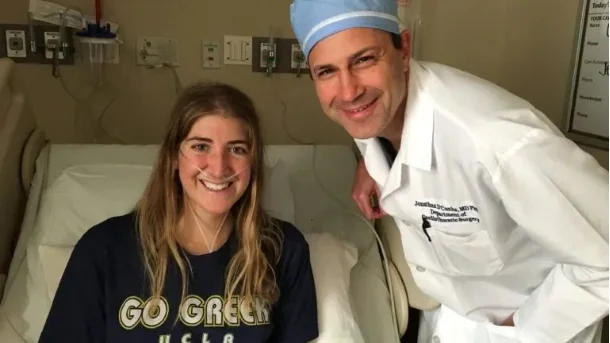
Mallory Smith with her physician, Dr. Jonathan D’Cunha, at the University of Pittsburgh Medical Center. Photograph: Diane Shader Smith, Mallory’s mother.
Mallory died a little more than a month after her 25th birthday. Her story, however, continued.
After reading the desperate appeal for a bacterial killer, two young people, Sacher and Zheng, created Phage Directory. The website invited researchers worldwide to register their phages and commit to sharing strains and information, helping accelerate future searches.
The B. cepacia strain that killed Mallory also survived. Researchers wanted to use it as bait to find a phage capable of lysing it and help prevent similar tragedies. Finding a suitable predator was difficult. The long evolutionary struggle between bacteria and phages does not always end in bacterial destruction: some phages replicate rapidly and lyse their hosts, while others integrate into bacterial genomes and reproduce with the bacteria without immediately killing them. Phage therapy requires the former. Many researchers screening against B. cepacia had instead found temperate phages of the latter kind.
The effort continued. The bacterial strain moved between scientists and laboratories, from Mallory’s hospital room in Pittsburgh to a laboratory in Jerusalem, some 6,000 miles away. There, Professor Ronen Hazan’s team at the Hebrew University hoped to build a phage collection against B. cepacia.
Hazan had long worked on phages and had also explored therapeutic applications. In 2019, his team reported a successful case involving phages combined with antibiotics for a bone infection caused by resistant Acinetobacter baumannii and Pseudomonas aeruginosa. To find additional phages, the researchers collected samples from many sources: hospital sputum, urine and stool, rivers, lakes, seawater and puddles after rain. Even team members going on holiday were asked to bring back soil, water or other samples.
The team also regularly sampled wastewater from a treatment plant in western Jerusalem. Despite the smell, they regarded sewage as a valuable source of phages. Their persistence paid off: they isolated a phage with strong lytic activity against Mallory’s bacterium. The team unanimously named it BCMallory1 in her memory, with BC referring to the host bacterium.
When Mallory’s mother heard the news, she cried. The discovery brought both comfort and grief: she hoped no one else would have to endure the same loss, while also feeling the pain that Mallory might have survived.
Steffanie Strathdee, co-director of the Center for Innovative Phage Applications and Therapeutics at UC San Diego, had herself seen her husband recover after phage therapy for a life-threatening A. baumannii infection. In her interview with STAT, she described thinking about Mallory every day and the determination to prevent another such loss. The lesson is to prepare in advance, so that when another patient like Mallory needs help, an investigational treatment can be considered without the same delays.
Part of this article draws on Eric Boodman’s STAT report, “A fitting memorial: Superbug treatment named for the patient who inspired its discovery”.