English translation updated . This article reflects the source material at its original publication date. Read the Chinese source.
This article discusses a published case of phage therapy for chronic bacterial prostatitis outside China, together with observations from our own clinical work.
The reported case
The patient described approximately six months of symptoms: severe pain in the right testicle radiating to the right buttock, right lower back and both sides of the pelvis, as well as perineal pain. He also experienced sweating, general weakness and malaise, and daily low-grade fever of 37.5–37.7°C with chills. He did not take antipyretics. Each morning, the chills lasted approximately an hour and a half.
Investigations found no abnormalities in the kidneys, ureters or bladder. Blood cell and white blood cell counts, erythrocyte sedimentation rate (ESR), C-reactive protein (CRP) and prostate-specific antigen (PSA) were normal. Urine bacterial and fungal cultures were negative. The prostate was of normal size, but a digital rectal examination showed tenderness. Pathogens were isolated from the prostate secretion and semen samples, including methicillin-resistant Staphylococcus aureus (MRSA), Staphylococcus haemolyticus, Enterococcus faecalis and a streptococcal organism whose species name is unclear in the archived source. Neither fungal growth nor gonococci were detected. The patient was diagnosed with chronic bacterial prostatitis.
Previous antibiotic treatment included a single dose of azithromycin, a course of doxycycline, a course of ofloxacin and, finally, oral ciprofloxacin combined with intravenous amikacin. His symptoms did not improve sufficiently during or after those courses, and he sought phage therapy.
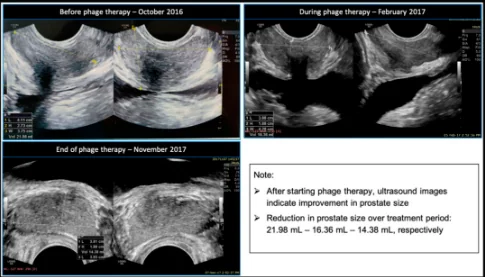
Clockwise: ultrasound images of the patient's prostate before, during and near the end of phage treatment. The original article attributes this image to the case report.
Treatment and follow-up
After screening phages against the patient's bacterial isolates in vitro, the researchers selected preparations for treatment. They administered phages orally, as rectal suppositories and by urethral instillation. The rationale described in the report was to combine systemic distribution through the oral route with local delivery through the rectal and urethral routes to reach the infected area.
Treatment lasted two months. Symptoms began to improve on the fifth day. At two months, ultrasound showed a reduction in prostate volume, and repeat testing of prostate secretions showed a lower bacterial burden. The report described resolution of the infection with no recurrence during nearly two years of follow-up.
Questions raised by the case
Our clinical experience has prompted interest in several properties of phages for chronic infections: their ability to kill susceptible bacteria, their narrow host range and the capacity of some phages to penetrate or disrupt biofilms. The original article also describes relatively few side effects in this context. These observations concern particular phages and treatment settings, rather than a guarantee for every infection.
In difficult infections, the interval between initial symptom improvement and resolution may extend from weeks to months. Phages can replicate in the presence of susceptible bacteria and may continue to act after administration stops. They can also be used alongside antibiotics. Phage–antibiotic synergy (PAS), and changes in bacterial antibiotic susceptibility associated with phage treatment, are areas of interest in research on multidrug-resistant organisms.
The original article further discusses possible immunomodulatory and anti-inflammatory effects, in addition to bacterial killing. It proposes that controlling infection and chronic inflammation might reduce the risk of later inflammation-associated disease, including malignancy. That proposed downstream benefit is not established by the individual case described here.
Many questions remain unresolved. Further research on phage therapy for chronic bacterial prostatitis in China may help clarify its potential and limitations.
Source note: the archived article cites a case report as reference [1], but does not provide its bibliographic details or a working reference link. The organism name and full citation require confirmation.