English translation updated . This article reflects the source material at its original publication date. Read the Chinese source.
1. Nebulized delivery
Nebulization converts a liquid into fine droplets that can be inhaled. For pulmonary delivery, the preparation is dispersed in a liquid medium, usually water, and mechanical or ultrasonic energy produces aerosol droplets carrying the material toward the lungs.
Different devices generate those droplets in different ways. A compressed-air or jet nebulizer uses the Venturi principle: air moving rapidly through a narrow opening draws liquid into the stream and toward a baffle. Fine droplets leave the device, while larger droplets are intercepted and recirculated.
The original article also describes two piezoelectric approaches. In one, high-frequency vibration acts through a transducer or mesh to produce droplets from the liquid. In another, ultrasonic energy is transmitted through a coupling medium, and cavitation within the liquid contributes to aerosol formation without a mesh. The source describes ultrasonic devices as producing a more uniform particle size than jet devices.
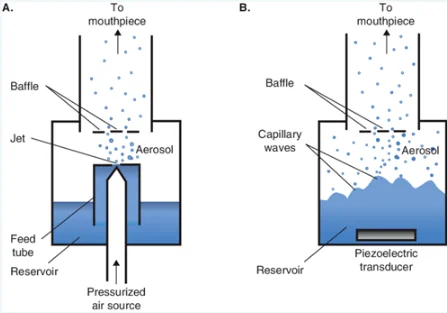
Figure 1. Schematic diagrams of a jet nebulizer (A) and an ultrasonic nebulizer (B). Image source: “Ultrasonic nebulization platforms for pulmonary drug delivery.”
Effects on phage integrity
Studies have examined how different nebulizers affect phages. Mechanical stress from high-speed air, thermal stress associated with ultrasonic energy, and shear or impact during repeated aerosolization can damage particles. Loss of tails or release of nucleic acid may reduce the number of infectious phages.
Turgeon and colleagues reported that genome copies in aerosol droplets after nebulization exceeded measured plaque-forming units (PFU) by more than 1,000-fold. This discrepancy indicated a loss of infectious activity consistent with structural damage.
Another study examined the Pseudomonas aeruginosa myophage PEV44 after passage through the three device types discussed in the source. The proportion of damaged phages increased, reaching 83% after jet nebulization and 50–60% after ultrasonic nebulization.
Leung and colleagues used transmission electron microscopy to compare phages with different morphologies. The short, non-contractile tail of PEV2 was relatively unaffected by jet nebulization. By contrast, the fraction of intact PEV40 particles, which have long contractile tails, fell to 27–50%; for D29, which has a long non-contractile tail, it fell to 2–15%. Long-tailed phages were therefore more susceptible to damage in these experiments, with tail loss the most frequent form of injury.
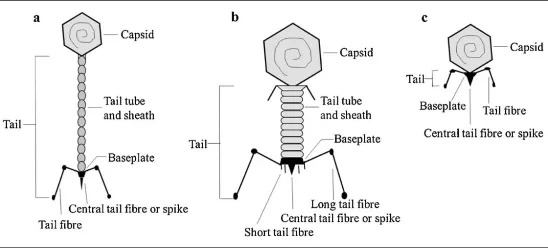
Figure 2. Three tailed-phage morphologies shown in the original article: (a) long non-contractile tail, (b) contractile tail and (c) short tail. Image source: “The ‘fighting wisdom and bravery’ of tailed phage and host in the process of adsorption.”
Formulation and environmental conditions
Relative humidity, temperature and the suspending medium may also affect aerosol performance. Liu and colleagues compared D29 preparations in deionized water, phosphate-buffered saline (PBS) and normal saline.
Deionized water produced more D29-containing aerosol droplets than either saline medium. Phages in those droplets retained greater measured activity, with PFU values 30–300 times those obtained using PBS or saline. The authors interpreted this as evidence that high salt and ion concentrations adversely affected bioaerosol stability in the tested conditions.
The droplets produced from deionized water had a reported mass median aerodynamic diameter of 2.4 μm, a size associated with delivery to smaller airways.
2. Dry-powder inhalation
Solid phage formulations provide another route for pulmonary delivery. A phage contains proteins and nucleic acid, and suitable dry formulations can improve stability compared with liquid preparations. Potential practical benefits include longer storage life and easier transport.
Dry-powder inhalers rely on the patient's inspiratory airflow rather than generating droplets through a nebulizer. However, preservation of phage activity still depends on preparation, formulation and delivery conditions. The original article discusses three principal production methods: spray drying, freeze drying and spray freeze drying.
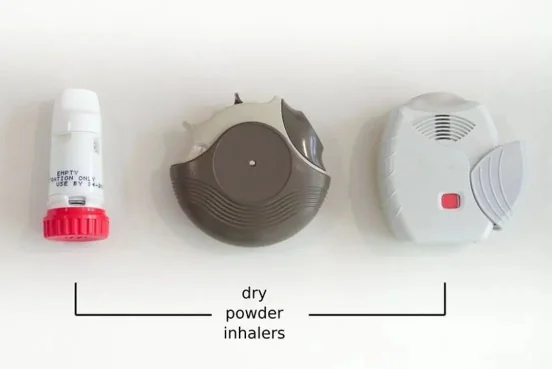
Figure 3. Examples of dry-powder inhalers. Image source: “Asthma Medications and Devices: Drug Delivery Devices.”
Spray drying
Spray drying disperses a liquid into heated drying gas. Water evaporates, leaving dry particles. Conventional high-temperature conditions can damage heat-sensitive phages.
Researchers used a modified low-temperature process to prepare inhalable powders containing KS4-M, KS14, KZ/D3 and a KZ/D3/KS4-M mixture. Trehalose helped protect the phages during dehydration, while leucine improved powder dispersibility.
Aerodynamic performance was assessed using mass median aerodynamic diameter (MMAD). The source describes particles in the 0.5–5 μm range as more likely to reach smaller airways, whereas larger particles tend to deposit in the throat. Powders produced by the low-temperature process in the cited study had an MMAD of 2.5–2.8 μm.
Freeze drying
Freeze drying first freezes the solvent and then removes water by sublimation under reduced pressure. Phage titer can decrease during the process. The resulting material may also require milling to reduce particle size below 5 μm, adding mechanical stress that can cause further losses.
Golshahi and colleagues prepared endotoxin-free KS4-M and KZ phage powders using a formulation containing 60% lactose and 40% lactoferrin as protective and stabilizing components. The powders were deagglomerated in a mixer mill to obtain inhalable particles.
The two phages lost approximately 10- to 100-fold in titer after freeze drying, while particle sizes were kept below 5 μm. Storage for three months at either 4°C or 22°C, with relative humidity controlled at 21.2%, produced little further loss of titer.
In an in vitro aerosol experiment, 10⁶–10⁷ PFU were collected downstream of the mouth–throat model. Compared with the starting inhaled powder, the reported titer reductions were 15.8-fold for KS4-M and 6.3-fold for KZ.
Spray freeze drying
Spray freeze drying combines droplet formation, freezing and sublimation. It can produce particles with aerodynamic properties suited to pulmonary delivery.
Leung and colleagues compared inhalable PEV2 powders made by spray drying and spray freeze drying. The spray freeze-dried formulation gave higher in vitro phage recovery. However, vacuum drying could still reduce activity.
Ly and colleagues investigated atmospheric spray freeze drying (ASFD) for D29. Preparations containing different concentrations of trehalose and mannitol were sprayed and frozen in a cold chamber. Cold, dry gas then removed ice by sublimation to form a free-flowing powder. With a trehalose-to-mannitol mass ratio of 7:3, the lowest reported loss was a 3.9-fold reduction in titer.
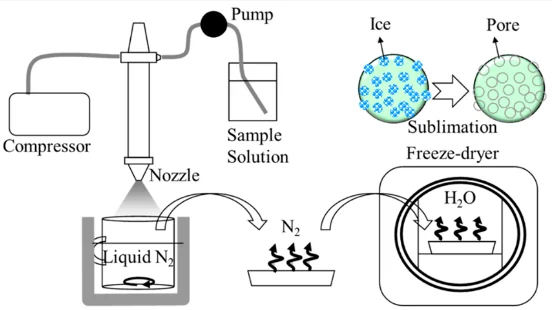
Figure 4. Schematic apparatus for spray freeze drying. Image source: “Development of Biodegradable Polycation-Based Inhalable Dry Gene Powders by Spray Freeze Drying.”
Deposition and dispersibility
Delivery to the lower respiratory tract depends on both the inhaler and the powder's ability to disperse in air. The fine particle fraction (FPF) is the fraction below a defined aerodynamic size threshold; the article uses 5 μm. A higher proportion of suitably sized, dispersed particles can improve delivery beyond the mouth and throat.
Micrometer-sized particles can be strongly cohesive and adhesive. Excipients may improve dispersion, but the formulation needs to be optimized for each preparation. Leucine and trileucine are examples used in spray-dried formulations.
3. Outlook
Nebulization and dry-powder inhalation are approaches being studied to deliver phages to respiratory pathogens. Their performance cannot be assumed to be identical for different phages or devices.
Optimization includes the delivery method, stabilizers, effects on phage morphology and viability, storage stability and lung deposition. Understanding these factors is necessary to assess the clinical potential of each formulation.